
Eye Chart
Parasitic Infections of the eye.
Excerpt:
Parasites can infect humans and once inside the body they travel to different organs including the eyes. If not treated, the infection can lead to eye problems and in some cases blindness. Parasites live outside or inside an organism and depend on the host for nutrients. Most parasites cause damage to the host. The Center for Disease Control and Prevention states there are 3 parasites that are responsible for causing disease in a human.(1) These are:
You Got Eye Parasites?
Excerpt:
Acanthamoeba is a single-celled organism found widely in water, soil, and air. This amoeba causes Acanthamoeba keratitis, a severe eye infection particularly affecting the cornea, the clear front part of the eye. It is frequently linked to improper contact lens hygiene, such as rinsing or storing lenses with tap water, or swimming while wearing the
Loa loa, also known as the African eye worm, is a helminthic parasite prevalent in West and Central Africa. Loiasis, caused by Loa loa, is contracted through repeated bites from infected deerflies (mango flies). Infected flies transmit microscopic larvae that mature and migrate throughout the body, sometimes becoming visible as they move across the eye’s conjunctiva.
EYE PARASITES?
Excerpt:
The eye, being one of our most vital sensory organs, is vulnerable to a variety of infections and diseases. Among these are ocular parasitic infections, a rare but intriguing category of eye disorders caused by parasites that find their way into the eye tissues. This article delves into the world of eye parasites, exploring their types, causes, symptoms, and available treatments.
Eye chart over time from 01-11-18 to 04-22-2025
| # | Date | EYE | SPHERE | CYL | AXIS | REFF NUMBER |
|---|---|---|---|---|---|---|
| 1* | 01/11/2018 | R | -2.50 | -1.00 | 96 | |
| 1* | L | -1.00 | -1.00 | 80 | ||
| 2* | 02/13/2019 | R | -1.00 | -0.50 | 90 | |
| 2* | L | 1.25 | -1.25 | 76 | ||
| 3* | 01/22/2020 | R | -1.75 | -1.25 | 92 | |
| 3* | L | -1.00 | -1.00 | 80 | ||
| 4* | 04/23/2021 | R | -2.25 | -1.25 | 95 | |
| 4* | L | -0.25 | -1.50 | 85 | ||
| 5* | 05/10/2022 | R | -1.75 | -1.25 | 85 | |
| 5* | L | 0.25 | -1.50 | 79 | ||
| 6* | 04/28/2023 | R | -2.00 | -1.50 | 95 | |
| 6* | L | 0.50 | -2.00 | 80 | ||
| 7* | 05/13/2024 | R | -2.25 | -1.25 | 97 | |
| 7* | L | 0.25 | -2.00 | 75 | ||
| 8* | 04/22/2025 | R | -1.50 | -1.75 | 99 | |
| 8* | L | 1.00 | -1.75 | 86 | ||
| 9* | 02/18/2026 | R | -2.25 | -1.00 | 94 | |
| 9* | L | 0.75 | -1.50 | 84 |
Eye Chart From 01-11-18 to 02-18-2026
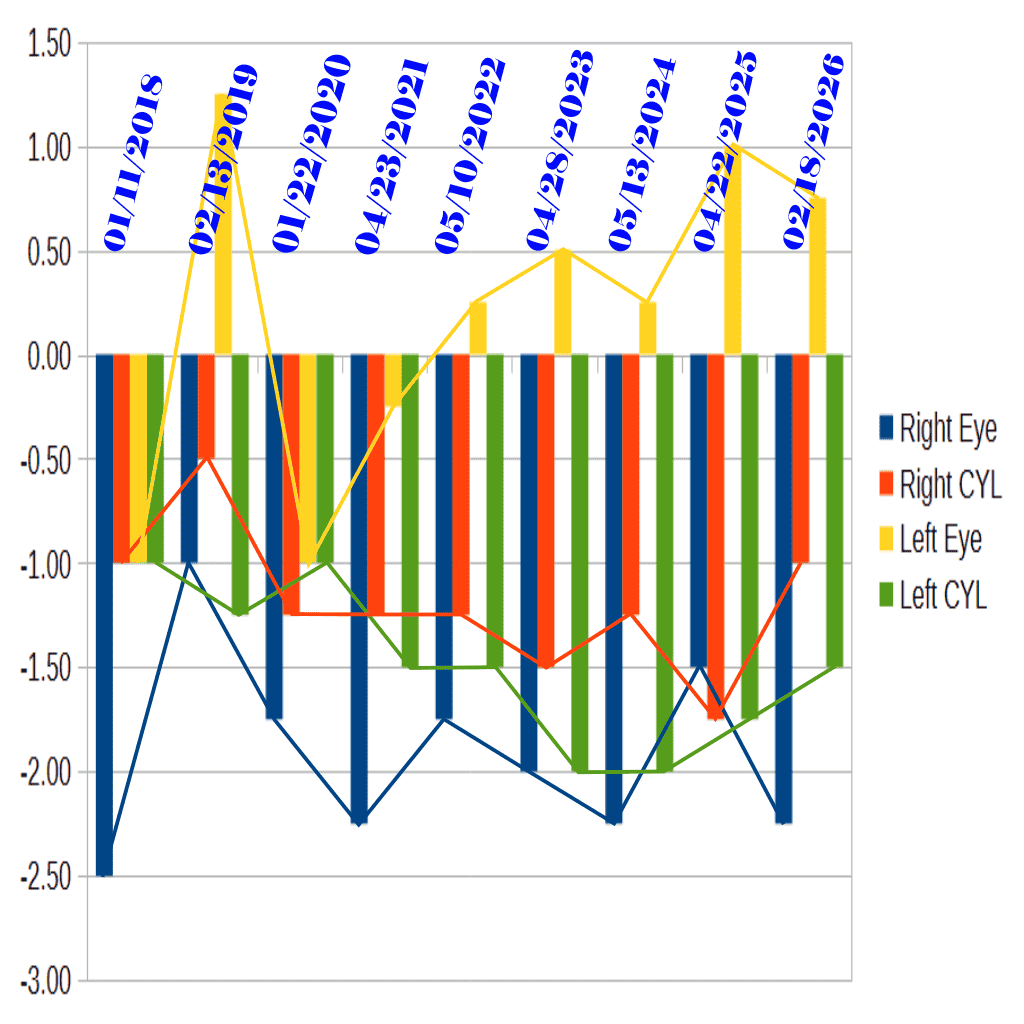
Note 1: Plus numbers Nearsightedness.
Note 2: Minus Numbers farsightedness.
Vision Chart Explained
Excerpt:
Decoding the Vision Chart
The vision chart is all about lines, letters, and strange squiggles. The top line on the chart is designated for 6/60 vision. The second line from the bottom is 6/6 and represents normal sight, commonly known as standard eyesight.
The Vision Chart is a tabular form of numerical and alphabetical elements that measures your visual acuity or sharpness of vision. This chart will provide the result that the doctors need to prescribe you glasses of contact if needed. Moreover, if you already wear corrective lenses, the results will reveal if your prescription needs to change.
Interesting eye observation.
I have an interesting observation with my left eye. The number changes from -1.00 Nearsightedness to +1,25 Farsightedness within one year. See Chart 01-11-2018 to 02-13-2019.
The right side eye is always in the negative numbers (Nearsightedness ). All the numbers change over the years, some get better and some get worse.
Norby
Farsightedness
Excerpt:
Farsightedness, also called hyperopia, is a common vision condition in which distant objects are clear, but close objects look blurry.
People with extreme farsightedness may only be able to clearly see distant objects. Those with mild farsightedness may be able to clearly see closer objects.
Nearsightedness
Excerpt:
Nearsightedness is a common vision condition in which close objects look clear but far objects look blurry. The medical term for nearsightedness is myopia. Myopia happens when the shape of the eye — or the shape of certain parts of the eye — causes light rays to bend or refract. Light rays that should be focused on nerve tissues at the back of the eye, called the retina, are focused in front of the retina instead.
Nearsightedness usually develops during childhood and adolescence. Typically, it becomes more stable between the ages of 20 and 40. It tends to run in families.